


Technology has changed wedding planning in some genuinely wonderful ways. Couples can send beautiful invitations without buying a single stamp, collect RSVPs without decoding someone’s handwriting and gather hundreds of candid guest photos with one QR code.
Artificial intelligence can build checklists, suggest color palettes, draft timelines and help write everything from website FAQs to vows. It can also confidently give you an answer that sounds wonderful and is completely wrong—but we will get to that.
I use technology in my own planning process because the right tools save time, improve communication and keep information organized. My clients have access to a private planning portal where we can manage tasks, budgets, vendors, documents, timelines and messages in one place.
Technology is a tool. It is not the person taking ownership of your wedding.
Here is what is currently available, what is actually useful and where a real planner still matters.
Digital Invitations Have Grown Up
Digital invitations are no longer limited to a basic email with a generic picture attached. Couples can now send polished invitations through email, text message, QR code or a private link.
Modern invitation platforms can offer:
Animated or video invitations
Matching wedding websites
Separate invitations for the ceremony, dinner and evening reception
Individual guest links
Automatic reminders for people who have not responded
Immediate updates when plans change
Printed invitations with a QR code connected to the wedding website
Joy combines digital invitations, wedding websites, guest lists and online RSVPs. Partiful provides a more casual option for showers, rehearsal dinners and other wedding-weekend events, with invitations delivered through text, email, WhatsApp or a shared link.
Apple Invites can also incorporate maps, weather information, shared photo albums and collaborative playlists. That is wonderfully convenient. It still cannot call your grandmother and explain why she accidentally marked herself as not attending.
Digital invitations can save money and make communication much faster. However, couples should consider offering a printed option for older guests or anyone likely to overlook an email or text.
RSVPs Can Collect More Than a Yes or No
Online RSVP systems can gather almost everything you need to know about a guest:
Meal choices
Food allergies and dietary restrictions
Plus-one names
Children’s names and ages
Accessibility needs
Hotel and transportation information
Shuttle reservations
Song requests
Attendance at the rehearsal dinner, brunch or other events
Current email addresses, phone numbers and mailing addresses
Some systems group guests by household and only display questions that apply to each person. An out-of-town guest may see questions about accommodations and transportation, while a local guest will not.
That information can then be exported for the caterer, venue, transportation company and seating chart.
It is a much better system than chasing 150 people through text messages. Still, someone must review the answers. If a guest enters “allergic to everything” or lists a plus-one you have never heard of, the computer will happily save it. It will not pick up the phone and clarify what that actually means.
QR Codes Can Collect the Moments You Never Saw
One of the most useful wedding technologies is private photo and video sharing through a QR code.
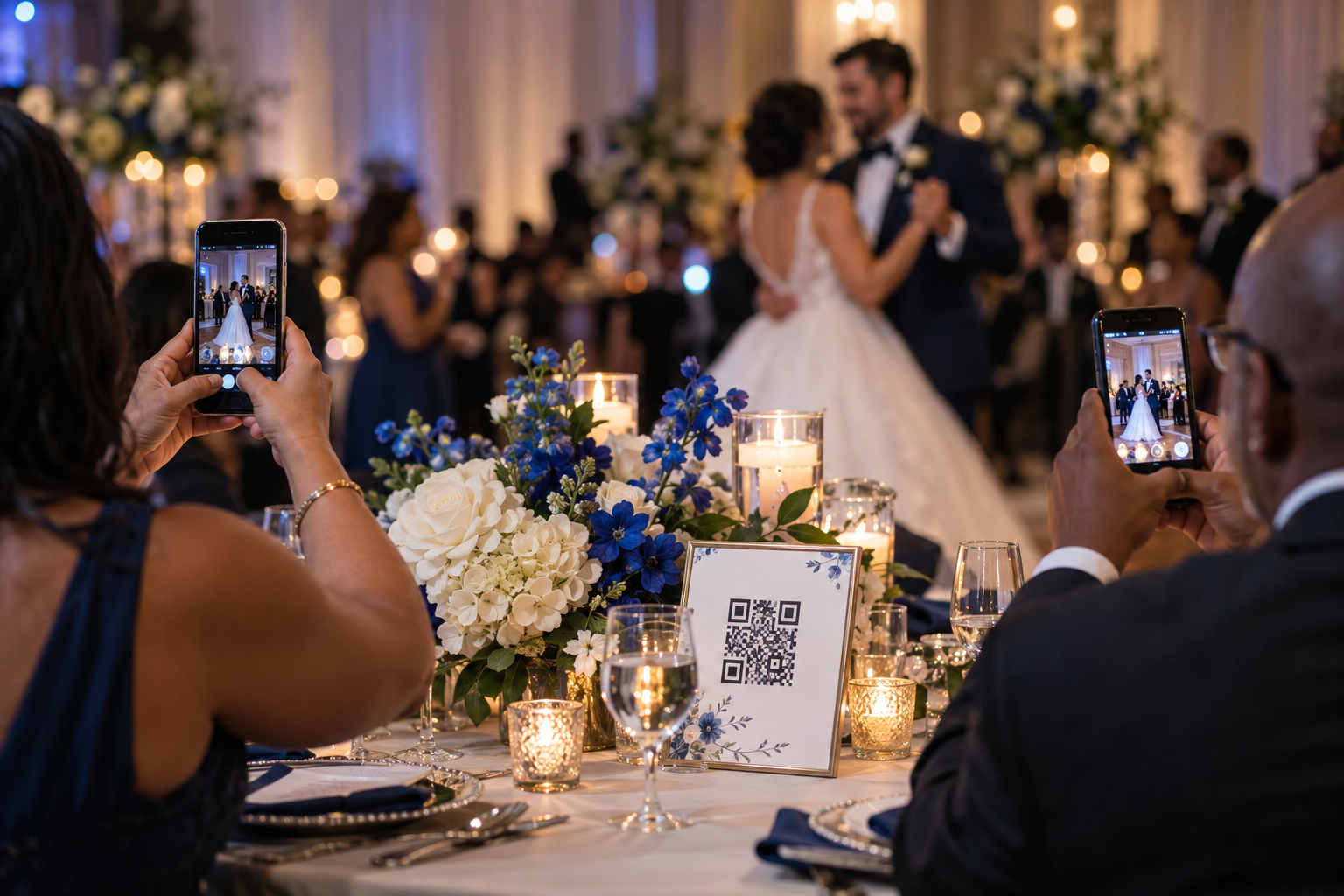
The code can be displayed on guest tables, at the bar, on welcome signs, inside hotel bags or on the ceremony program. Guests scan it and upload their photos and videos to one private gallery.
Guestpix allows guests to contribute photos, videos and digital guestbook messages without downloading an app or creating an account.
Other options include:
Live photo walls showing approved images during the reception
Digital disposable-camera apps that limit the number of pictures guests can take
Galleries that remain hidden until the following morning
Wedding “I Spy” photo challenges
Video guestbooks
AI-assisted tools that sort images and identify duplicates
These galleries are a wonderful addition to professional photography. They are not a replacement for it. Your guests may capture hilarious, touching and completely unexpected moments. They may also upload 47 blurry pictures of the dance floor and someone’s half-eaten dessert.
If photos will appear on a live screen, use a moderation setting. Trust me on that one.
Wedding Websites Can Become a Guest Information Center
A good wedding website can serve as the central source of information for the entire celebration.
It can include:
Dates, times and locations
Maps and directions
Hotel blocks
Shuttle information
Dress-code guidance
Frequently asked questions
Registry links
Online RSVPs
Private pages for invited guests
Weekend schedules
Calendar links
Real-time announcements
My rule is simple: if five guests have asked the same question, the answer probably belongs on the website.
A website can reduce repetitive questions. It cannot guarantee that everyone will read it. Someone will still text the bride on the wedding morning to ask what time the ceremony begins. Technology has limits.
Planning Portals Keep Everything in One Place
Planning platforms can replace scattered emails, screenshots, notebooks and spreadsheets with one shared workspace.
Depending on the system, couples and planners can manage:
Tasks and deadlines
Budgets and payments
Vendor contact information
Contracts and documents
Guest lists
Seating charts
Timelines
File uploads
Messages
Planning activity
This is why I offer my clients access to a private Elevate by Grace planning portal. Technology gives us one organized place to work together. I can see what has been completed, identify missing information and keep documents from disappearing into a 200-message text thread.
The portal stores the plan. I am still the one reviewing it, asking questions and recognizing when two vendors believe the other one is responsible for the same task.

AI Can Help Build a Plan
AI can be very helpful during the early and organizational stages of wedding planning. It can:
Create a preliminary checklist
Suggest a starting budget allocation
Draft questions for vendors
Summarize lengthy documents
Organize brainstorming notes
Produce an initial timeline
Draft website wording and FAQs
Suggest décor concepts
Generate mood boards
Create packing lists
Develop rain-plan checklists
Translate guest information
It can give couples a starting point when they feel overwhelmed. I am not anti-AI. I use modern tools, and I appreciate anything that saves time without sacrificing care or accuracy.
But please notice the words preliminary, initial and starting point.
AI can produce a wedding timeline in seconds. It does not know that your venue has only one service elevator, your photographer needs 20 minutes for sunset pictures, the caterer requires two hours of kitchen access or your grandmother cannot walk the distance from the ceremony to the reception.
Unless someone provides that information and knows why it matters, AI is arranging times on a page—not coordinating a wedding.
AI Can Design Invitations and Décor Concepts
Tools such as Canva’s Magic Studio can create first-draft invitation designs, remove backgrounds, resize graphics and generate wording or images.
Couples can use these tools for:
Save-the-dates
Invitation suites
Welcome signs
Seating displays
Bar menus
Weekend itineraries
Favor tags
Social graphics
Mood boards
Custom illustrations
The results can be beautiful. They can also include misspelled names, strange hands, impossible flowers or a wedding date that has somehow changed between the invitation and RSVP card.
Every AI-assisted design needs to be checked for spelling, dates, addresses, print resolution and accuracy before it goes to print. “The computer made it” will not be comforting when 150 invitations have the wrong ceremony time.
Seating Charts and 3D Floor Plans Are Worth Exploring
Digital floor-planning tools allow couples, planners and venues to build layouts to scale rather than guessing what might fit.
Prismm offers 2D and 3D floor plans, seating arrangements, guest management and collaborative planning.
These systems can help:
Move guests between tables
Track meal selections
Test different room layouts
Position bars, buffets, DJs and dance floors
Identify crowded pathways
Account for accessibility needs
Share updated plans with vendors
Walk through the space virtually
A lovely 3D rendering is helpful. A planner still needs to ask whether servers can carry trays through the room, whether guests can reach the restrooms and whether the DJ has access to power. A room can look beautiful on a screen and function terribly in real life.
More Technology Entering the Wedding World
Couples can also choose from:
QR-code ceremony programs and menus
Collaborative playlists
Online song-request forms
Audio guestbooks using vintage-style telephones
Video-message booths
Digital guest check-in
Live streaming
Real-time captions and translation
Facial-recognition photo searches
Virtual photo booths
Digital tipping and honeymoon contributions
Text alerts for transportation, weather and schedule changes
AI-written vows and speeches
Guest-service chatbots
Some of these are genuinely useful. Some are fun. Some solve a problem no one at your wedding actually has.
Before paying for another platform, ask three questions:
Does this make the experience easier for us or our guests?
Will people realistically use it?
Who is responsible for managing it?
If guests need three apps, two passwords and a tutorial before they can attend the wedding, we may have wandered away from convenience.
What AI Cannot Do on Your Wedding Day
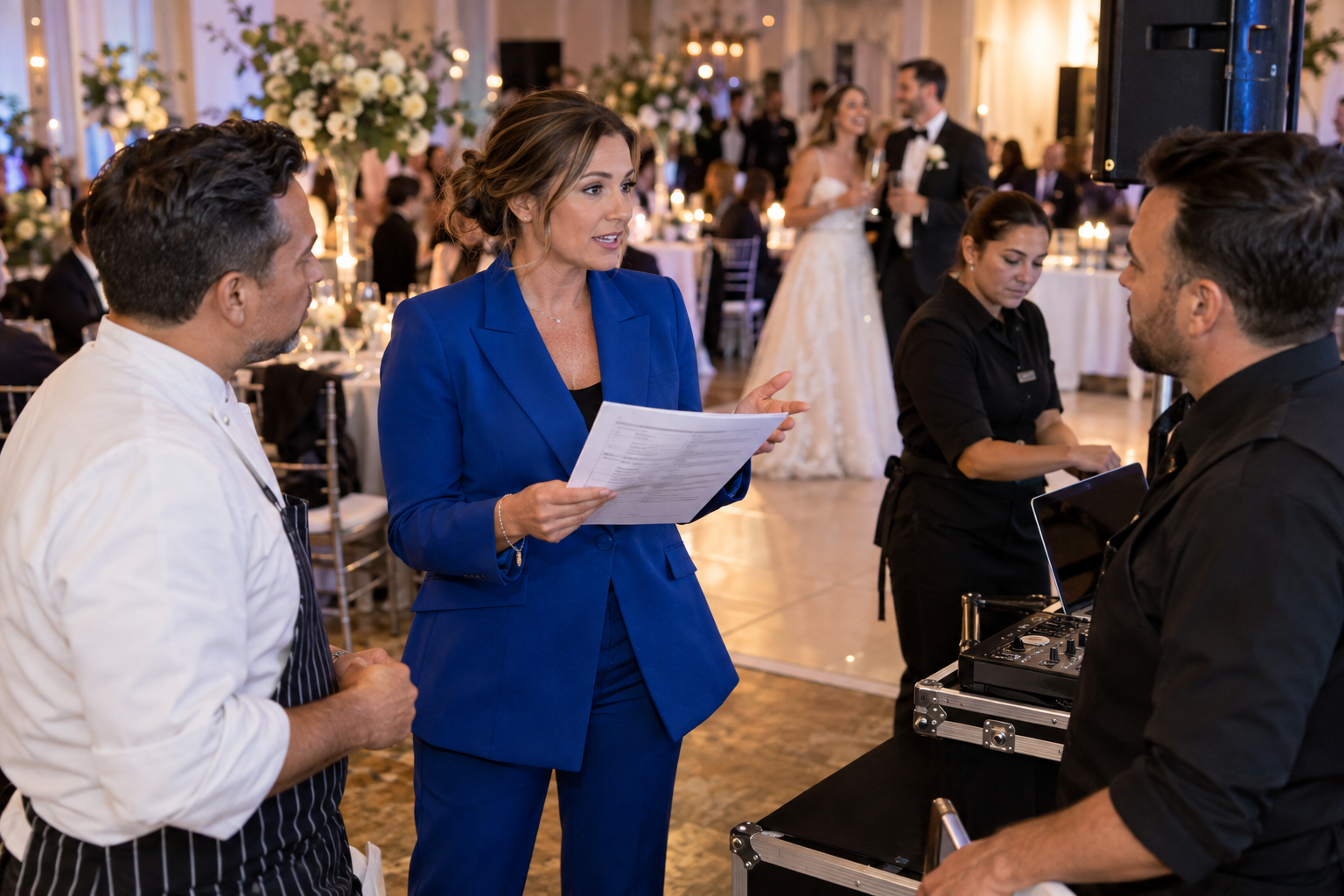
AI cannot walk into your venue and notice that the tables are set incorrectly.
It cannot find the florist when the bouquets have not arrived. It cannot calm a nervous parent, redirect late guests, pin a boutonnière, move a ceremony indoors or tell the DJ that introductions need to wait because the photographer is changing a lens.
It cannot read the expression on a couple’s face and know they need five quiet minutes before entering the reception.
It cannot diplomatically handle a vendor who insists something is “not in the contract” while keeping the issue away from the couple.
It cannot see rain moving across a field, smell that dinner may be burning or hear that the microphone is feeding back.
And despite its confidence, AI has never actually attended your wedding.
A planner does more than create documents. A planner interprets those documents, verifies responsibilities, sees the gaps, anticipates problems, communicates with people and adjusts the plan in real time.
The Best Combination Is Technology Plus Experience
For most couples, I recommend:
One wedding website with online RSVPs
One planning portal for tasks, documents and communication
One private QR-code gallery for guest photos
One digital seating and floor-plan tool
AI for drafting, brainstorming and organization
An experienced planner or coordinator to verify and execute everything
Use technology to reduce busywork. Use AI to help organize ideas. Then place the actual wedding in the hands of someone who understands people, vendors, venues, timing and what happens when the plan changes.
AI may be able to create a checklist.
I am the person who notices the one thing that never made it onto the checklist—and makes sure it is handled before you ever know there was a problem.
Michelle Waldron
Owner & Lead Event Planner
Elevate by Grace Event Company
www.elevatebygrace.events
mwaldron@elevatebygrace.events
Where Vision Meets Grace
