

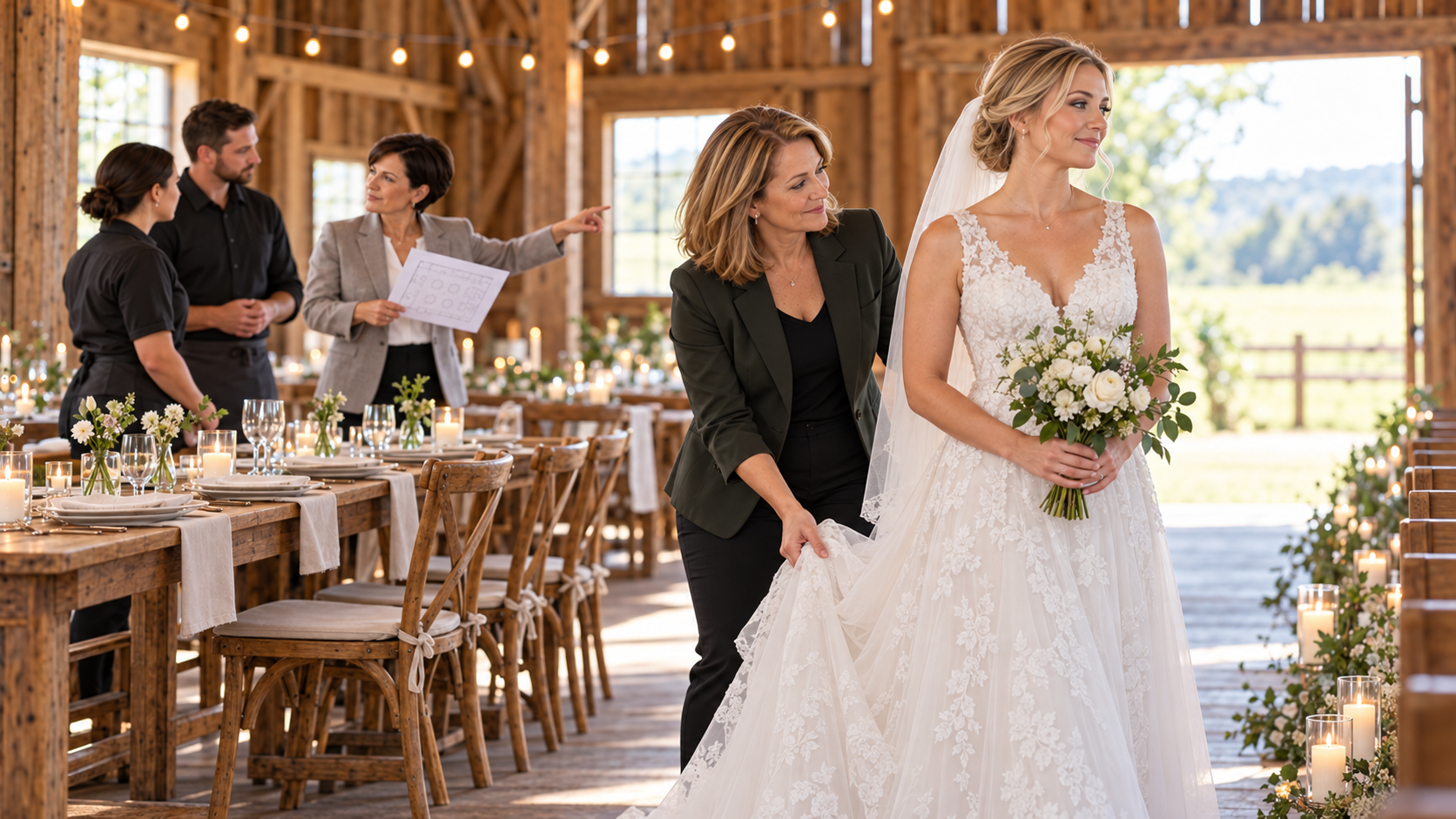
Two roles with a mutual goal
The venue coordinator executes the responsibilities included in your venue contract, while the wedding coordinator supports the couple and oversees the vendors, timeline, personal details and overall flow of the entire wedding day.
You found a beautiful venue, signed the contract and were told there would be a venue coordinator available. Wonderful—you can cross wedding coordination off your list, right?
Not necessarily.
Venue coordinators and wedding coordinators can both be incredibly valuable, but they usually have different responsibilities. Understanding those differences before your wedding can prevent confusion, missed details and the dreaded day-of question: “Wait…who was supposed to handle that?”
Who Does the Venue Coordinator Work For?
A venue coordinator works for the venue. Their primary responsibility is making sure the venue fulfills what is included in your contract.
Depending on the property, that may include:
Opening and closing the venue
Managing venue employees
Overseeing venue-owned tables and chairs
Coordinating in-house catering or bar service
Answering questions about venue policies
Monitoring building access and vendor arrival times
Making sure venue rules are followed
Addressing problems involving the property
Some venue coordinators go far beyond these responsibilities, while others have a very limited role. Neither approach is necessarily wrong—it depends on what the venue includes in its services.
The important thing to remember is that the venue coordinator represents the venue. Their attention may also be divided among the building, staff, catering operation and other events taking place that day.
Who Does the Wedding Coordinator Work For?
Your wedding coordinator works for you.
Their focus is not limited to the building or one department. They are looking at the complete celebration—from the ceremony and vendor arrivals to your reception timeline and end-of-night plan.
A wedding coordinator may handle:
Reviewing your plans, contracts and timeline before the wedding
Communicating with all confirmed vendors
Confirming arrival times and responsibilities
Directing the rehearsal and ceremony processional
Keeping the wedding party informed and organized
Overseeing personal décor and special details
Coordinating transitions throughout the day
Managing speeches, dances, dinner and other scheduled moments
Troubleshooting unexpected problems
Helping organize gifts, cards and personal belongings
Directing teardown according to the agreed plan
Most importantly, your coordinator becomes the central point of contact. Instead of vendors, family members and venue staff bringing every question to you, they bring those questions to the person you hired to protect your plans.
“But My Venue Said They Have a Coordinator”
That is great—but ask what the word “coordinator” means at that particular venue.
Wedding-industry titles are not always standardized. One venue coordinator may help run the ceremony, communicate with vendors and manage the entire timeline. Another may only be responsible for the building, venue staff and services purchased directly from the venue.
Before assuming everything is covered, ask:
Will you communicate with my outside vendors?
Will you create or manage the complete wedding-day timeline?
Will you direct the rehearsal and ceremony?
Will you line up and cue the wedding party?
Will you set up our personal decorations?
Will you move ceremony décor into the reception?
Will you manage gifts, cards and personal items?
Will you stay through the end of the reception?
Will you help with teardown and packing?
Who handles a problem involving a vendor who is not connected to the venue?
Get the answers in writing and compare them with your venue contract.
What Happens When No One Owns the Complete Day?
Most wedding-day problems are not caused by a lack of caring. They happen because everyone believed someone else was handling a particular responsibility.
The venue thought the florist was moving the ceremony flowers. The florist thought the coordinator was doing it. The family assumed the venue staff would pack the decorations. Meanwhile, the couple is trying to enjoy dinner while answering questions about boxes, candles and vendor arrival times.
A good wedding coordinator identifies these gaps before the wedding and assigns responsibility. That preparation is just as important as the work performed on the actual day.
Do You Need Both?
In many cases, yes—and they should work together as a team.
A strong venue coordinator understands the property, its rules, its staff and its operations. A wedding coordinator understands the couple’s complete vision, vendor team, personal details and priorities.
When both professionals communicate clearly, the venue is protected, the plans are executed and the couple receives the support they expected.
Ask the Questions Before the Wedding
Do not assume that “a coordinator is included” means every detail of your wedding is covered. Ask what is included, what is not and who will be responsible for anything that falls between the two roles.
Your family and wedding party should be celebrating with you—not running around with a clipboard, calling vendors or trying to figure out where the cake knife disappeared to.
At Elevate by Grace Event Company, coordination begins before the wedding day. I take time to understand your plans, review responsibilities, communicate with vendors and identify details that still need an owner. On the day itself, my role is to keep everything moving while you remain present for the celebration you worked so hard to create.
To learn more about planning and coordination services, visit www.elevatebygrace.events or email mwaldron@elevatebygrace.events.
Elevate by Grace Event Company
Where Vision Meets Grace
Double-click to edit...
